Pin It button on image hover
Showing posts with label social studies. Show all posts

Saturday, July 6, 2013

Independence Day + Close Reading


I have been motivated by my patriotic spirit....I am so incredibly blessed to be part of this fabulous nation, and weekends like this remind me of all of the great things that our country has to offer.

One of the most difficult things I am finding with all of our new initiatives is being able to find time to teach social studies and science.  Many people are okay with pushing them aside in favor of more reading time, and while I am a huge proponent of reading, I also believe that we need to expose our students to necessary background information in the content areas. 

I think what I have created will help in a couple of ways.  It will allow me to incorporate more exposure to history and geography while also exposing students to more reading of nonfiction.  In addition, the hope would be that kids will begin to pick up on key words in the text to help them solve the question.

What I am attaching is a sampler of what I made for my class.  It is an activity called "What's My Name?"  I will display it in my room by revealing a clue each day of the week and offering students the chance to guess who/what they think it is.  I have seen commercial versions of things like this before, but I think they typically are just people.  In my version, I am also including cities and landmarks.

Feel free to use if you wish.  It is nothing fancy, but it is good information.  I learned some new things preparing these pages.    I hope you and your students enjoy!


Click on the flag for the link to the What's My Name Sampler

Wednesday, February 29, 2012

Government Online Resources

I have been putting together my government unit, and here are some online resources that I have found...


This site has some simple little review games for the kids to do over the branches of government, checks and balances, and the executive branch


This is another nice site which covers the basic of government for kids.  It was created for a Thinkquest competition.


This Congress for Kids site focuses on Ithe legislative branch.


This PBS site was created for the 2008 Election, but it still has a lot of good information!


t
This site offers an interactive field trip of our nation's capital.


This site has a good Washington D.C., webquest.

I really enjoy teaching social studies, and government is one of my favorite things to teach.  One thing that makes it difficult though is with the spiral curriculum, it is difficult to get the kids excited about something that they have learned about already in the last two years and will learn about again for the next two years, so I am always trying to find new and interesting ways to engage them.  One thing I do is that I focus on our government in Illinois.  That seems to help somewhat. :)

I hope you find these worthwhile.  I would love to know of any other great resources that you have used or have seen--even those that aren't websites!

Wednesday, February 15, 2012

Interactives for the SMARTBoard

This site has a great set of resources for the SMARTBoard, but they could also be used individually with students on their own devices.

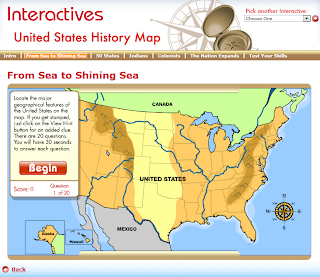
I am highlighting the US history one, but there are many great ones at this site.  I found that even though many are listed for older children, there were pieces in each one that I could use with my 3rd graders--either as a whole class lesson or as an extension for some of my high-achieving students.


The US history map above has some pretty nice features.  It breaks US history into categories, does a short lesson on it, and then has students participate in an interactive review.  You can skip through the eras if you don't want to do them all.  At the end of the map there is a comprehensive review assessment that students can do and receive their score.

Check out these interactives.  They cover all content areas.  I think they are worth your time!

Saturday, February 11, 2012

Lincoln talkers

As part of our study of Lincoln, the students create these Lincoln talkers.  They actually make them and fill them with words or quotes for their Lincoln recital text.

Students are shown a model, receive an explanation of what to do, and are given a circle to use for the talker, but that is it.  I like that they all look so different.  The kids do a nice job making the head outline, and then they add details to that.


The mouth opens to reveal words or phrases from a speech that President Lincoln gave or part from a poem about President Lincoln.


This activity forces children to choose what they think is most important in their piece of writing, because they typically can't fit the whole text into his mouth.  Also, it puts them into the practice of reviewing the text again so that they are prepared to recite it to the class.


I have used these talkers for different things over the years.   I have had students make themselves and fill the mouth with adjectives about themselves, had them be other famous people we are studying and put ideas that they think they would say, make leprechauns and fill the mouth with a limerick....the possibilities are endless!

I hope you can find a use for them with your kids.  Let me know if you have other ideas for uses!  ( I love comments!)

Sunday, February 5, 2012

Mt. Vernon virtual mansion tour

Have you ever been to Mt. Vernon, George Washington's home?  It is located in Virginia, a short distance from Washington, DC.

I have been lucky enough to go there a couple of times.  It is a beautiful estate, and it oozes the feeling of importance that it should.  How cool is it to touch the banister that George and Martha Washington did?  I love that kind of stuff!

Anyway, while looking for more Presidential information, I came upon a virtual tour of Mt. Vernon.  I think it would be a great thing to share with students.  Click on the picture below to access the tour.


If you get the chance to visit our nation's capital, I highly recommend making the effort to get out to Mt.Vernon.  It can be accessed by public transportation (train and bus), and it is well worth it!  Plan on a long visit--the mansion is beautiful and interesting, but the museum located on the estate grounds is interactive, informative, and fun, too!

Wednesday, February 1, 2012

RAFT follow-up

So we concluded our unit on Jane Addams with the RAFT project I blogged about earlier.  I was so pleased with the students' output!  They worked very hard, and used their computer time so wisely so that it could be completed at school.  Nearly all of them completed it at school.


This year, each of the RAFT options were chosen by someone!  I think that is a first.  I am including some of the final projects for your reading pleasure.  :)  I hope that if you don't know much about Jane Addams, you know more after reading their projects.  More importantly, I hope that you can see that they learned about Jane Addams!  :)


Sunday, January 29, 2012

Presidents Day Videos

Below are some great videos to share with your class for Presidents' Day.  Even if you don't take the time to teach all of the Presidents during this month, at least these short videos acknowledge (in most cases) all of them.


This is one of my favorites!  The Presidents morph from Washington all of the way to Obama.  Kind of freaky--but the kids like it!


This rap song isn't bad and is current by listing all of the Presidents in order.


This one is set to Johnny Cash's song, "That Ragged Old Flag."  Powerful song.  This Presidents' pictures only cover through the second President Bush.


This is a simple one that shares all of the Presidents through Obama.


Finally, I like the Animaniacs song.  I just don't know how comfortable I am sharing it with 9 year olds.  It also ends with President Clinton.

Saturday, January 28, 2012

Presidents Day and Fraboom!


Have you tried the website called Fraboom?  It calls itself an online children's museum.


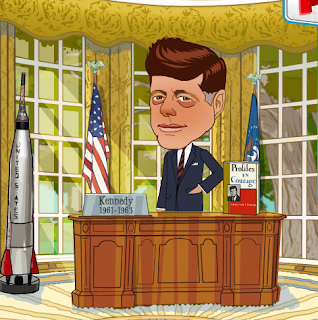
The website has many parts to it, but I wanted to share the Presidents exhibit with you.  Click on President Kennedy to go this part of the site.

Here, students can learn about different Presidents, and by finding the interactive elements of the Oval Office, learn different details about his life and Presidency.  There is also a neat little replica of the White House where students can get an idea of what it looks like.


There is another part of the site, called Fraboom TV, and on  that section, students can watch short videos that cover everything from how to draw a cartoon mouth to how a bill becomes a law.  Kids I think will love  it, and I like that it offers me a new way to present some of my material. 


 Fraboom is a free website, but it does offer a $5.99 per month membership where you gain access to more of the site's elements.  I found the free site and its components to be enough to keep me busy for a  while!


Sunday, January 22, 2012

Building Reading Fluency

     We all know how important reading fluency can be to a student's ability to read.  In our classroom, we have found a way to emphasize fluency and enjoy poetry, too!

     About five times during every school year, my class  has a poetry recital.  The children choose a poem on Monday, and then have until Friday to work and prepare it to read to the class on Friday.
We invite our parents or other special people to come listen.

     This is a great opportunity for students to become more comfortable speaking in front of a group (even though we do it A LOT, this is a more formal situation), but it is also an excellent chance for students to learn to be a good audience.

     Here's how it works in my room:  I choose the poems--usually about 10 more than the number of students in my classroom.  (I do a lot of seasonal poetry or poetry that ties into things we are learning)  I distribute them around the room so that students have options in front of them.  If they look through the poems in front of them and are unable to find one they like, then they can get up and look at others that were placed around the room.  My poetry choices are usually pretty diverse from Shel Silverstein and Jack Prelutsky to Robert Frost and Langston Hughes.

After students find the poem that they want, they bring it to me, we discuss whether it looks like a good fit, and I attach the rubric below to it.  I then go through my set of duplicate poems and find the one they chose and put their names on them.  That way, they have a copy, and I have a copy at school for the week, and to use when I score the recital.

     During the week, we often do some things with the poems:  students often practice with parent volunteers, I model good expression and volume, students answer questions about their poem, sometimes they create an illustration to accompany the poem, they practice with partners...  For my kiddos with special needs, I make extra copies of their poem for the speech pathologist and/or the LBS I.   Often times they type the poem up in Boardmaker or put other visual clues on it to help the children.

     On Friday of the recital, I "shuffle" my copies of the poems, and that determines the order.  Students tear off the little half-sheet rubric and give it to me, present their poem, and I use the copy I have to mark miscues or other things to note.  I complete the rubric as the child reads, attach it to the poem copy and Voila!, on to the next student.
Click on the image to download your copy of the rubric!

     I have learned that this assignment is often difficult for my best readers.  They practice so much that they DO memorize the poem, and then they sound like Speed Racer up there reciting the poem.  That is why I highly encourage students not to memorize, and I teach them to place marks in the text so that they remember to pause or to take a breath.  By the end of the year, students are pretty good with this.

     There are many things I have tried over the years with this, and a lot of them depend on the group I have.  Sometimes I have allowed students to choose music to play softly in the background while they read.  I have also allowed students to read their own poetry.  Another time, I recorded kids reading their poems on the Flip video and had them self-assess.  I'm sure you have a lot of great ideas of ways you could tweak this idea.

     The recital that we will do in February is one of my favorites.  Being the Land of Lincoln, we spend a lot of time learning about Honest Abe.  Our February recital is a mixture of poems written about Abe, by Abe, or speeches/quotes attributed to President Lincoln.  This offers kids the opportunity to really think about the purpose of the poem or speech and to focus on setting the correct mood or tone with their reading.  Now, for this one, I generally assign students what they are going  to read rather than letting them choose.  I split the Gettysburg Address into 4 parts, and those four present it together, but receive separate grades.  I even have a top hat kids can wear if they want!

Friday, January 13, 2012

Family Artifact "Show and Tell"

This week, my students did show and tell of a sort.  :)  They shared an artifact from their family that is important to them.

I have done this activity in conjunction with the story The Hundred Penny Box for a number of years. (If you haven't read this heart-touching story by Sharon Bell Mathis, you really should!)  Anyway, Aunt Dew in the story has an old box that contains pennies---1 for every year of her life.  One of our vocabulary words for the book is PRECIOUS, and we really discussed how the box is precious to Aunt Dew but might not be precious to someone else.  The same is true with the family artifact.  It was an item that might or might not have monetary value, but it was precious to the child and his/her family.

This year, we had another great variety from the students.  Antique sleigh bells from a great grandfather that the family rings before opening Christmas presents, a shaving cup from Sweden that a boy's father received from his grandfather, china from Japan that a soldier in Korea asked his army buddies to pick up for him so that he could get back to the States, Hindu god idols that students have displayed and use in their homes and were sent here from their family in India...

It always powerful to learn how completely different our backgrounds but how we are all drawn to those same small reminders of family and loved ones--things that would have no value to anyone else, yet to us...PRICELESS. 


I usually choke up a couple of times during this activity.  I point out to the students that the items are important to us because even though some of us never knew or met the person who the object originally belonged to, they are someone who makes us who we are.  I share my artifact with them as a model.  My grandfather's class book that he made of his 1928 graduating class from Beaver Crossing High School in Beaver Crossing, Nebraska.  I am lucky to have a copy of his graduation ceremony program, and an announcement that he sent to his sister, too.  All small items that would have little value to anyone else besides the fact that they are old, and the photographs of the 1928 graduates look like movie stars even though they were probably all farmers' daughters and sons and had never left Nebraska.  However, even as I write this, thinking about that book makes me think of that wonderful loving man who made me laugh, played games with me, came to my music programs, and confided in me once that he thought of all of my sisters, I was the most like my mom.  :)  He is certainly one of the people who continues to make me who I am, just as my students are made by the pieces of the lives of the people who came before them.

Yet we are all together today.

Sometimes it is important to share our diversity so that we can appreciate how alike we really are.

Sunday, January 8, 2012

Have you ever used a RAFT?

RAFT is a student choice project which allows students to show their knowledge of a subject in a variety of ways.

The above RAFT is one I created for a unit we are doing on Jane Addams.  Students have 6 project options that they can do which shows their knowledge of Jane Addams.

RAFT stands for Role, Audience, Format, and Topic. Students read across the row to determine which project will be best for them.  For example, a student may choose to be a social worker who is writing a letter to his parents explaining to them why he is so glad that he chose to be a social worker.  In the letter, he would list the jobs that a social worker at the beginning of the 20th century would have done.  This would be done in a way that keeps the voice of a child to a parent and follows the format of a letter.

The formats labeled DIGITAL are broad on purpose.  I have tried to expose my students to many different online tools as well as other publishing tools, and the digital term means they can use any of them...Photostory, Prezi, Glogster, Powerpoint, SMART Notebook...  All children will be encouraged to type their project.  Time is given in class for the work to be done because it is an assessment, and I want the child's ideas.

Have you ever used a RAFT?  In what subject did you use it?  The students appreciate the choice options, and I like the differentiated options that can reach learners at all levels show their understanding in a way that best suits them.

You can access a copy of the above RAFT plus the rubric I use to score it by clicking on the image above.

Saturday, September 10, 2011

Remembering 9/11 with students who weren't even alive yet...


     Since July, I have been thinking about how to mark the 10th anniversary of 9/11 with my students.  They are only 8 years old, and they have not idea of the way the world stopped that day for so many of us.  Besides that, they are still too young to be exposed to many of the details of the day.  However, for myself, I knew I couldn't just ignore the day.

     Last weekend, I was reading an article in the paper that mentioned the total number of people lost that day.  I thought that that was what I wanted to have my kids realize--the number of people lost that day.  So...after a great brainstorming session with my fellow 3rd grade teachers, we made a plan of how to show our students the nearly 3000 people lost that day.

    What we did was this...We divided the number of people who died that day by our students and teachers.  Each student would then be responsible for coming up with a set number of positive, patriotic words.  (For our students, it was 25 a piece.)  We helped the students generate their lists by listening to patriotic music, reading patriotic books, watching the Brainpop 9/11 video, books about 9/11 like The Little Chapel that Stood...

     Finally, we had the students write their words onto two tall "towers" of roll paper.  Kids were assigned a color to write in, and we had a key to show that the colors helped to show the number who died in NYC, the Pentagon, Shanksville, and Emergency Personnel.  The towers were filled with patriotic words (brave, liberty, freedom, heroes were commonly used). 

     Our fabulous PE teachers let us hang these huge papers in the gym so that all kids would be able to see them.  Our custodian helped us to hang them because they were so big.  It was unbelievable even to us teachers as to how full these towers were with words.  We hope that our kids have a better understanding of the impact that this event had on our country, and how the events of that day united us as Americans.

     I have pictures of our towers, but they are at school.  I will post them later.  I think they were a very appropriate way for us to present this event to our young students, and I hope that it made an impact on them.  It certainly made an impact on me.